 Hire Angular Developer
 Hire React
Developer
 Hire Flutter Developer
 Hire Bootstrap Developer
 IOS app developer
 React Native
developer
 Wearable App Development
 Cross-Platform
Developer
 IoT App Developer
 Hire Node JS
Developer
 Hire PHP
Developer
 Hire Laravel Developer
 Hire CI
Developer
 ASP.Net developer
 Vue.js Developer
 Java App Development
 Python Developer
 Hire Full Stack Developer
 Hire MEAN Stack Developer
 Hire MERN Stack Developer
 Android app developer
 Low Code App Developer
 NFT Marketplace Developer
 Metaverse Developer
 Machine Learning Chatbots
Developer
 Telemedicine App
 Remote Monitoring System
 Electronic
Medical Records
 Hotel Room
Booking App
 Medical Billing
Software
 Hospital
Management System
 Health
Information Exchange
 Medical Legal Case
Management
 Healthcare
Marketplace
 DICOM Viewer
 Food Ordering &
Delivery
 Event & Show Booking App


Everyone Is Selling Software. But Who Is Actually Listening? Why Businesses Need Technology That Understands Them
The Real Problem Isn't a Lack of Software. It's a Lack of Understanding.
Walk into almost any business today, and you'll find conversations about technology.
Someone wants an ERP system. Another department is looking for a CRM. Management wants AI-powered automation. The operations team needs better reporting, while the sales team wants a system to track leads and customer interactions.
There is no shortage of software options.
Yet many businesses continue to struggle with the same problems they had before investing in technology.
Employees still depend on spreadsheets. Information gets lost between departments. Important customer inquiries go unnoticed. Managers struggle to understand daily operations, and repetitive activities consume hours of productive time.
Why does this happen?
Because buying software and solving a business problem are two very different things.
The real starting point of digital transformation should not be a discussion about which software to purchase. It should be a conversation about what is preventing the business from operating better.
When Business Problems Get Mistaken for Software Requirements
Consider a business owner who says:
"We need an ERP system."
At first, this sounds like a straightforward software requirement. But what is actually happening inside the business?
Perhaps inventory is maintained manually, purchase orders are difficult to track, and different departments maintain separate records.
In that situation, ERP might be an appropriate solution. But the decision should come after understanding the actual operational problems.
Now consider another business owner:
"We need an AI-powered system."
After understanding the requirement, it turns out that employees spend several hours every day extracting information from documents and entering it into internal systems.
Perhaps document processing automation, combined with carefully applied AI, could solve the problem more effectively than building an entirely new AI platform.
The distinction is important.
Businesses should not have to adapt their operations simply because a particular software product is available. Technology should be selected and designed around the way the business needs to operate.
The Questions Every Technology Conversation Should Start With
Before recommending a platform, framework, or software solution, a technology partner should understand the business environment.
Here are some questions that can reveal more than a long list of requested features:
1. Where Is Your Team Spending Too Much Time?
Identify repetitive tasks that consume employee time.
Examples include:
Manually entering customer information.
Preparing reports using multiple spreadsheets.
Sending repetitive emails and notifications.
Updating records across different applications.
Managing approvals through disconnected communication channels.
The objective is to identify activities that can be simplified, automated, or connected.
2. Where Is Information Getting Lost?
Information gaps can create operational problems even when a business already uses several software applications.
For example, a sales team might maintain customer details in a CRM, while the operations team works through separate spreadsheets.
When information is not properly connected, employees may work with outdated records or repeatedly request the same information.
A connected software solution can help create better information visibility across departments.
3. What Is Preventing Management from Making Better Decisions?
Business owners and managers need reliable operational information.
If management cannot easily understand sales performance, inventory levels, employee activities, project progress, or pending tasks, important decisions may be delayed.
Well-designed dashboards, reporting systems, and business analytics can help address these visibility challenges.
4. Which Processes Are Creating Unnecessary Complexity?
Sometimes the problem isn't that a business lacks software. It is that its existing processes have become unnecessarily complicated.
Too many approval steps, duplicate data entry, disconnected tools, and unclear responsibilities can slow down operations.
Before adding another application, it is worth examining whether the existing workflow can be improved.
One Industry, Different Businesses, Different Technology Needs
One of the biggest mistakes in software consulting is assuming that every business within an industry needs the same solution.
Two companies can operate in exactly the same industry and still have completely different workflows, priorities, customers, and operational challenges.
This is why domain understanding matters.
Let's look at a few examples.
Healthcare: Better Patient and Operational Workflows
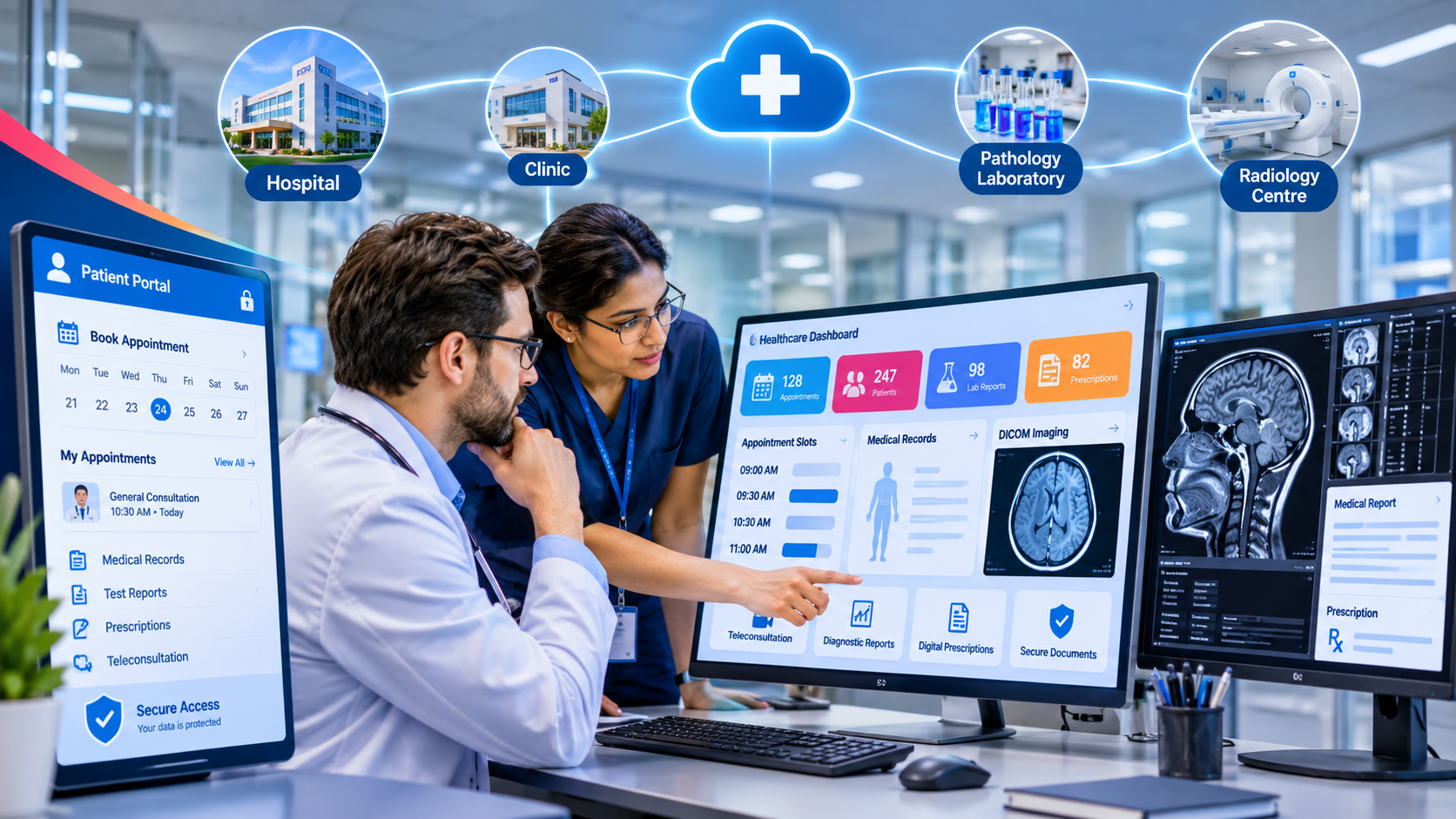
A healthcare organization may struggle with patient registration, appointment coordination, medical documentation, diagnostic reporting, and information management.
The solution might involve connecting healthcare applications, improving patient management workflows, and reducing repetitive administrative activities.
The important part is understanding how healthcare operations actually function before deciding which systems should be developed or integrated.
Logistics: Visibility Across the Supply Chain
A logistics company may face challenges involving vehicle allocation, shipment tracking, warehouse coordination, delivery updates, and documentation.
Its technology requirements could include fleet management, shipment tracking, warehouse systems, customer portals, and operational reporting.
A generic business application may not adequately address these interconnected requirements.
Manufacturing: Control Over Production and Inventory
Manufacturing businesses often need better visibility into production activities, raw material availability, inventory movement, procurement, and quality-related processes.
A suitable solution may involve manufacturing management software, inventory systems, production planning, and integrations between different operational departments.
Understanding the production environment is essential before designing the software.
Education: Connecting Students, Teachers, and Administration
Educational institutions may need systems for student admissions, attendance, examinations, fee management, learning resources, and parent communication.
A digital platform should reflect the institution's actual administrative and academic processes rather than simply provide a collection of generic features.
E-commerce: Connecting Sales With Operations
An e-commerce business may have challenges involving order management, product inventory, payment processing, shipping, customer support, and returns.
Its technology requirements may involve connecting an online storefront with inventory management, payment gateways, logistics providers, and customer management systems.
SaaS Businesses: Building Around the Product and Its Users
A SaaS company may need subscription management, role-based access, user onboarding, usage analytics, billing automation, integrations, and scalable infrastructure.
The right architecture depends on the product's business model, target audience, expected usage, and future direction.
These examples demonstrate one important principle: technology should reflect the operational reality of the business.
Why Domain Knowledge Changes the Quality of Software
Technical knowledge helps developers build applications. Domain knowledge helps them build applications that actually make sense.
Imagine developing a logistics application without understanding how dispatch operations work.
A developer might successfully create vehicle records, shipment forms, and tracking screens. However, the application may still fail to support actual dispatch workflows, delivery exceptions, warehouse coordination, or operational reporting.
The same applies to manufacturing, healthcare, education, and other industries.
When a development team understands the domain, it can:
Ask more relevant questions during requirement analysis.
Identify missing business scenarios.
Understand dependencies between departments.
Design more practical workflows.
Avoid unnecessary features.
Recommend appropriate integrations.
Anticipate industry-specific challenges.
Domain knowledge also helps reduce the gap between what a client requests and what the business genuinely needs.
Custom Software vs. Ready-Made Solutions: What Should a Business Choose?
Not every business needs custom software.
Ready-made platforms can be an excellent choice when their functionality aligns with the organization's requirements.
However, difficulties can arise when a business has unique workflows, specialized integrations, or requirements that existing products cannot adequately support.
Here is a practical comparison:
| Business requirement | Potentially suitable approach |
|---|---|
| Standard accounting operations | Ready-made accounting software |
| Common customer management | Existing CRM platform |
| Unique internal workflows | Custom software |
| Industry-specific operations | Specialized or custom-built platform |
| Connecting multiple existing applications | API and system integration |
| Repetitive document processing | Workflow automation or AI-assisted automation |
| Specialized reporting across departments | Custom dashboards and analytics |
The best solution is not necessarily the most expensive or technically advanced one.
It is the solution that addresses the business requirement effectively while remaining practical to maintain and expand.
In many situations, a combination of existing software, custom development, and integrations delivers better results than replacing every system.
The Role of AI and Automation: Solve the Right Problem First
Artificial Intelligence and automation have created exciting opportunities for businesses.
However, implementing AI without a clearly defined business objective can lead to unnecessary complexity.
Instead of asking, "Where can we add AI?", businesses should ask:
"Which activity is consuming resources, creating delays, or producing avoidable errors?"
For example:
AI-assisted document extraction can help process information from supported documents.
Automated workflows can reduce repetitive approval activities.
CRM automation can help organize lead follow-ups.
Intelligent reporting can help summarize operational information.
AI-powered search can make relevant business information easier to retrieve.
The technology should be chosen according to the problem, not the popularity of the technology itself.
AI is valuable when it delivers a measurable operational benefit and is implemented with appropriate oversight, security, and data quality controls.
What a Good Technology Partner Actually Does
A technology partner should contribute more than development resources.
The relationship should begin with understanding the business, not immediately preparing a quotation based on a feature list.
A good partner takes time to:
Listen to the Business
Understand the organization's objectives, operational challenges, customers, and expectations.
Study Existing Processes
Evaluate how departments work, how information moves, and where inefficiencies occur.
Identify the Actual Problem
Separate the underlying business challenge from the software solution initially requested.
Recommend Practical Technology
Evaluate whether existing software, custom development, integrations, AI, or automation would be most suitable.
Build Around Real Requirements
Develop a solution that supports actual workflows instead of forcing employees to follow an unsuitable process.
Support Long-Term Growth
Consider maintainability, future integrations, scalability, and evolving business requirements.
This approach creates a stronger foundation for successful software projects and long-term technology partnerships.
How Web N Soft Solution Approaches Business Technology
At Web N Soft Solution, we believe every successful software project should begin with a clear understanding of the business problem.
We work across different business domains, including healthcare, logistics, manufacturing, education, e-commerce, and SaaS-driven business operations.
Each domain brings its own workflows, operational requirements, and technical challenges.
That is why we believe in understanding the process before recommending the technology.
Whether a business needs custom software, workflow automation, ERP or CRM solutions, AI-powered applications, system integrations, or a scalable digital platform, the focus should remain on solving the actual business requirement.
Technology is most effective when it fits naturally into the way an organization operates.
Conclusion: Listen First. Then Build.
The software industry is full of companies offering ERP, CRM, AI, automation, and custom development services.
But the real difference between a software vendor and a valuable technology partner is the ability to understand what a business is trying to achieve.
A successful digital transformation doesn't begin with selecting a programming language, purchasing a software license, or adding another dashboard.
It begins by asking the right questions.
Where is the business losing time? Which processes are slowing down operations? What information is missing? What needs to work better?
Once these questions are answered, the technology decisions become much clearer.
Because businesses don't need more software simply for the sake of having software. They need solutions that understand their problems and make their operations better.
At Web N Soft Solution, our philosophy is simple:
We Listen First. Then We Build.
Have a Business Challenge That Technology Could Solve?
Whether you're looking to improve existing operations, automate manual workflows, integrate multiple systems, or develop custom software for your organization, start with a conversation about the problem.
Connect with Web N Soft Solution and let's explore a practical technology solution for your business.
Web N Soft Solution – Technology Built Around Your Business.